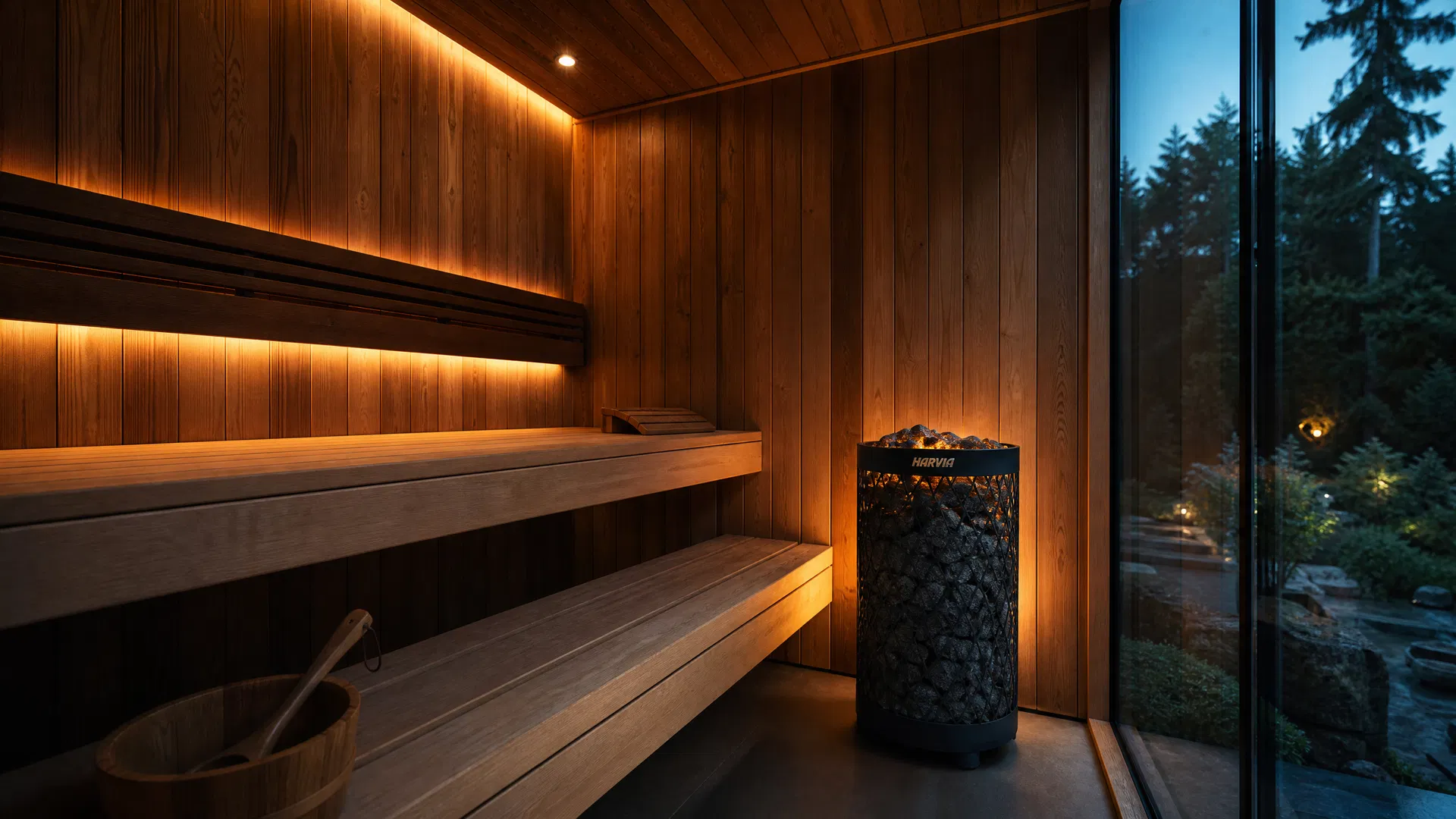
The cost of a bespoke sauna is not a single number — it is the sum of six key decisions. Here is exactly what drives the price, and how to get the most from your budget.
One of the most common questions we receive is: "How much does a bespoke sauna cost?" The honest answer is that it depends — not on vague variables, but on six very specific decisions that you will make during the design process. Understanding each one empowers you to plan your budget intelligently and invest where it matters most to you.
At South Coast Sauna Co, every sauna we build is designed completely from scratch around your space, your lifestyle, and your specification. There is no standard model and no hidden cost — just a clear, itemised quotation delivered within 48 hours of your free consultation. Here is a breakdown of every factor that influences the final price.
1. Size: The Single Biggest Cost Driver
Sauna size is the primary determinant of cost. A larger sauna requires more timber, a more powerful heater, additional insulation, and more labour — all of which compound. As a rough guide, a compact 1–2 person indoor sauna installation will typically cost significantly less than a 6-person garden pavilion, even when specified with identical materials.
The key dimensions to consider are floor area, ceiling height, and bench configuration. A sauna with a higher ceiling requires more volume to heat and more timber to line. Double-tier benches (upper and lower) use more alder or cedar than a single-bench layout but dramatically improve the experience — particularly for families or couples who use the sauna together regularly.
- —1–2 person sauna: approximately 1.2m x 1.5m floor area
- —3–4 person sauna: approximately 1.8m x 2.1m floor area
- —5–6 person sauna: approximately 2.1m x 2.4m or larger
- —Ceiling height: 2.0m–2.2m is standard; higher ceilings increase volume and heater requirements
Our advice: do not undersize. Many clients who initially request a 2-person sauna end up using it with family or friends. A slightly larger footprint is rarely regretted, and the incremental cost per square metre decreases as the sauna grows.
2. Timber Species: Aesthetic, Durability, and Price
The interior timber is the material you will see, touch, and smell every time you use your sauna. It defines the aesthetic entirely — and it has a significant impact on cost. There are four main species used in high-quality bespoke sauna installations:
- —Clear Alder (Alnus glutinosa): The traditional Finnish choice. Light, smooth, low resin content, and excellent thermal properties — it stays cool to the touch even at high temperatures. Mid-range price point.
- —Western Red Cedar (Thuja plicata): Aromatic, visually striking, and naturally resistant to moisture and decay. The scent is part of the experience. Premium price point.
- —Thermowood (heat-treated spruce or pine): Thermally modified for enhanced durability and a rich, dark tone. Excellent for outdoor saunas. Premium price point.
- —Nordic Spruce: A cost-effective option with a clean, pale aesthetic. Suitable for clients who prioritise budget without compromising on quality.
The grade of timber also matters. Clear-grade timber (no knots) commands a premium over knotty grades. For a luxury finish, we recommend clear-grade alder or cedar throughout — the visual difference is immediately apparent and the surface is smoother to the touch.
3. Heater: The Heart of the Sauna
The heater is not an area to economise on. A correctly specified heater from a reputable manufacturer will last 15–20 years with minimal maintenance. An undersized or low-quality heater will struggle to reach temperature, cycle on and off excessively, and fail prematurely. We work exclusively with Harvia, Huum, and Narvi — the three leading Finnish manufacturers.
The key specification is power output, measured in kilowatts (kW). As a rule of thumb, you need approximately 1kW per cubic metre of sauna volume. A 2-person sauna with a volume of around 4m³ requires a 4–6kW heater. A 6-person sauna with a volume of 10m³ requires a 10–12kW heater. The cost difference between entry-level and premium heaters from the same manufacturer can be £500–£1,500.
- —Electric heaters: The most common choice for indoor saunas — clean, controllable, and easy to install.
- —Wood-burning heaters (kiuas): Authentic Finnish experience with a crackling fire. Requires a flue and is more common in outdoor garden saunas.
- —Harvia Cilindro: Our most popular electric heater — cylindrical stainless steel design, excellent stone capacity, and a 10-year warranty.
- —Huum DROP: A premium option with a striking aesthetic and exceptional heat distribution.
4. Glazing: Glass Doors, Panels, and Windows
Glazing is one of the most impactful — and most underestimated — cost factors in a bespoke sauna. A standard sauna door with a small glass panel is the entry-level option. A full-height frameless glass door with a matching glass side panel is a significant upgrade in both cost and visual impact.
The most dramatic option is a full glazed wall — floor-to-ceiling glass on one side of the sauna, typically facing a garden or terrace. This transforms the experience, flooding the interior with natural light and creating a visual connection with the outdoors. It is also the most expensive glazing option, as it requires specialist sauna-rated glass, additional structural framing, and careful thermal engineering to prevent excessive heat loss.
- —Standard sauna door with glass panel: Entry-level — functional and clean.
- —Full-height frameless glass door: Mid-range — dramatically improves the aesthetic.
- —Glass door plus fixed glass side panel: Our most popular configuration — light, open, and visually striking.
- —Full glazed wall: Premium — transforms the sauna into a statement architectural feature.
- —Roof window or skylight: A popular addition for garden saunas — natural light and stargazing.
All glazing used in our saunas is specified for the thermal environment — standard double-glazing units are not suitable. We use toughened, heat-resistant glass throughout.
5. Lighting: The Detail That Defines the Atmosphere
Lighting is the detail that separates a good sauna from an exceptional one. The difference in cost between basic overhead lighting and a fully considered bespoke lighting scheme is relatively modest — but the difference in experience is profound.
All lighting in a sauna must be specified for the thermal environment. Standard domestic LED fittings are not rated for the temperatures and humidity levels inside a sauna and will fail rapidly. We use sauna-rated fittings throughout, typically sourced from Harvia, Cariitti, or Tylö.
- —Under-bench LED strip lighting: Warm amber glow at low level — the most flattering and atmospheric option. Our standard recommendation.
- —Recessed ceiling spotlights: Clean and minimal. Must be sauna-rated.
- —Chromotherapy (colour-changing) lighting: Popular with clients who want to customise the mood. Adds a modest premium.
- —Fibre optic star ceiling: A premium option — creates a stunning night-sky effect. Significant cost addition.
- —Backlit sauna stone wall: A dramatic feature for larger installations.
6. Insulation: The Foundation of Performance
Insulation is the least visible but arguably the most important component of a well-built sauna. Proper insulation determines how quickly the sauna reaches temperature, how efficiently it maintains heat, and how much it costs to run over its lifetime. Cutting corners on insulation is a false economy.
For indoor sauna installations, the walls and ceiling are typically insulated with 100mm mineral wool or rigid foam board, with a vapour barrier on the hot side to prevent moisture migration into the building structure. For outdoor garden saunas, the insulation specification is even more critical — the structure must perform in winter temperatures and resist driving rain and wind.
- —Mineral wool (rock wool): The standard insulation choice — excellent thermal and acoustic performance.
- —Rigid foam board (PIR/PUR): Higher performance per mm — useful where space is limited.
- —Vapour barrier: Essential on the hot side of the insulation to prevent moisture damage to the building structure.
- —Aluminium foil facing: Reflects radiant heat back into the sauna, improving efficiency.
- —Floor insulation: Often overlooked — an insulated floor dramatically reduces heat loss and improves comfort underfoot.
A well-insulated sauna will reach 80–90°C in 30–45 minutes and maintain that temperature with minimal heater cycling. A poorly insulated sauna may take over an hour to reach temperature and struggle to hold it — resulting in higher running costs and a less satisfying experience.
Putting It All Together: What Should You Budget?
A bespoke sauna from South Coast Sauna Co is a considered investment — not a commodity purchase. Our projects range from compact indoor installations to large garden pavilions with full glazing, premium timber, and integrated wellness features. Every project is priced individually based on your specific specification.
The best way to understand what your sauna will cost is to book a free consultation. We will assess your space, discuss your requirements, and deliver a full written quotation with detailed CAD drawings within 48 hours — at no cost and with no obligation. We serve clients across Dorset, Hampshire, Bournemouth, Poole, Southampton, and across the South of England.
Ready to start your sauna project? Book a free design consultation — CAD drawings and a full written quotation within 48 hours.
Get Your Free Sauna Quotation →